
Erectile Dysfunction
Dysfunction
Erectile dysfunction (ED) is a common condition. ED affects 50% of men over the age of 40. Although it is not life-threatening, it can negatively affect your quality of life. Since it can be related to other conditions, such as heart disease and diabetes. It is important that you get the right treatment. There are various treatment options for ED, discuss with your doctor which option is best for your individual situation.
Impotence is actually an outdated term for this condition. We prefer to use the term erectile dysfunction.
An erection can indeed malfunction in various ways, meaning it no longer functions normally. The firmness of the erection may be insufficient, the duration of the erection may be too short, ejaculation may be difficult or occur too quickly, there may be a curvature of the penis during erection, or there may be problems with libido (sexual desire) or orgasm (reaching climax).
Impotence is the medical term used to describe the inability to achieve or maintain sufficient penile rigidity (erection) for a certain period of time. This is an issue that every man may face at some point in his life. Because it is a sensitive topic, it is rarely discussed openly among men. At work or in social settings, other men often appear to be “supermen” in bed… The truth is, erectile dysfunction can happen to anyone. In the United States, it is estimated that 30 million men experience this problem! Fortunately, erectile dysfunction is almost always treatable. Sometimes it is a temporary condition, and other times more permanent solutions need to be considered.
Before we discuss the causes and treatments, let us first explain the mechanism of a normal erection.
How Does a Normal Erection Occur?
The penis contains two large erectile bodies (called the corpora cavernosa) and a urethra, which is surrounded by a much smaller erectile body (the corpus spongiosum). The two large corpora cavernosa are located on the top side (when looking down at the penis), while the urethra and the corpus spongiosum lie underneath. Additionally, the penis contains blood vessels and nerves that are essential for sensing stimulation and achieving an erection.
You can best think of an erectile body as a sponge: it is made up of many small interconnected chambers. When the penis is flaccid, these chambers contain very little blood. Inside the erectile bodies run arteries that supply blood. In the flaccid state, these arteries are narrowed (almost like they are in a state of spasm), so the incoming blood is almost immediately drained away by veins that lie against the thick, elastic walls of the erectile bodies.
When a man becomes sexually aroused, the blood vessels within the erectile bodies open up, allowing much more blood to flow into the penis (normally about 250 ml, or the volume of one glass, every two minutes). The erectile bodies then begin to swell, compressing the veins against their walls so that blood can no longer drain out. This causes the penis to become firm and remain erect. At this point, the erection is complete.
This erection mechanism is also influenced by hormones and coordinated by the nerve supply to the erectile bodies. An erection is therefore a very delicate process, requiring precise coordination of several components. If this coordination is disrupted, the firmness of the penis may be reduced, or an erection may fail to occur altogether. Sometimes a good erection occurs but disappears too quickly. All these forms of erectile dysfunction result from a failure of this finely tuned mechanism.
Source: Belgian Association of Urology (BAU)


Education and
Couple assessment

Oral Medication

Intracavernous
Injections

Vacuum Erection
Device

Penile Prosthesis
What is a Penile Prosthesis?
Three-piece Inflatable Penile Prosthesis Series
A penile implant, also called a penile prosthesis, is a medical device which is surgically implanted into the erection chambers of the penis in case of severe ED.
A penile implant is an option if you have tried PDE5Is and Intracavernous Injections and both had little effect on ED. It may also be recommended if you can not use PDE5Is or the drugs in the injections. If you have tried PDE5Is and injections but are unhappy with the results and you want a permanent solution, a penile implant may be an option for you.
How To Prepare?
It is important to follow your doctor’s instructions carefully in order to prepare for surgery. This includes not eating, drinking, or smoking for a specified period of time before the procedure and discussing any current medications with your doctor. It is also important to follow any other instructions given by your doctor, such as showering with a special soap, avoiding certain activities, or arranging for transportation to and from the hospital. By preparing carefully, you can help ensure that your surgery goes smoothly and that you have the best possible outcome.
Penile Prosthesis Surgery Procedure
For penile implant surgery, you will receive either general or spinal anesthesia. You will also get a urinary catheter, which can be removed the day after surgery. Once you are under anesthesia, the doctor will make a small incision either above the penis or between the penis and the scrotum. The incision exposes the erectile chambers, and the surgeon measures them to place a penile implant of the correct length. Once the cylinders are in place, the reservoir is placed behind the abdominal wall, and the pump is placed in the scrotum between the testicles to conceal the pump.
Finally, all elements of the implant are connected, and the incision is sutured. The wounds are cleaned, and a compressive bandage is applied. Most surgeons choose to leave the penile implant inflated for one day. Some surgeons prefer to leave a drain, which is then usually removed one day after the procedure.
After the Penile Prosthesis Surgery
In the first 2-3 days after surgery, there may be a small amount of discharge from the incision. There is no need to treat this since it usually stops on its own.
For 4-6 weeks after the surgery:
- Do not lift anything heavier than 5 kilograms.
- Do not do any heavy exercise and avoid bike riding.
- Do not take thermal baths or go to the sauna.
- Discuss any prescribed medication with your doctor.
- Your doctor will schedule an appointment to inflate the implant for the first time. This is done once the swelling and soreness have gone, about 4-6 weeks after the procedure.
- After the appointment, you may start having sexual activity.
You should notify your urologist if:
- The swelling is severe or not improving.
- You have a discharge of a large amount of fluid each day.
- The pain gets worse or does not improve.
- You notice increased redness or tenderness around the incision site.
- You have a fever.
Benefits of Penile Prosthesis:
- Low rate of mechanical failure.
- It is possible to inflate the device discreetly.
- Inflatable implants are easy to conceal.
- No risk of priapism.
- Highest level of satisfactory outcome out of all possible treatments.
- Highest level of patient satisfaction of all ED therapies if the patients and their partners are informed correctly about what to expect from the implant.
Types of Penile Prosthesis:
a) Three-piece inflatable penile prosthesis:
Three-piece inflatable penile prosthesis consists of a pair of cylinders implanted in the penis, a pump implanted in the scrotum, and a reservoir implanted in the lower abdomen. Three-piece inflatable is a self-contained fluid-filled (usually saline) system made from silicone. When the fluid within the reservoir is pumped manually into the cylinders by rapidly pressing and releasing the pump, the inflation creates an erection that provides rigidity.
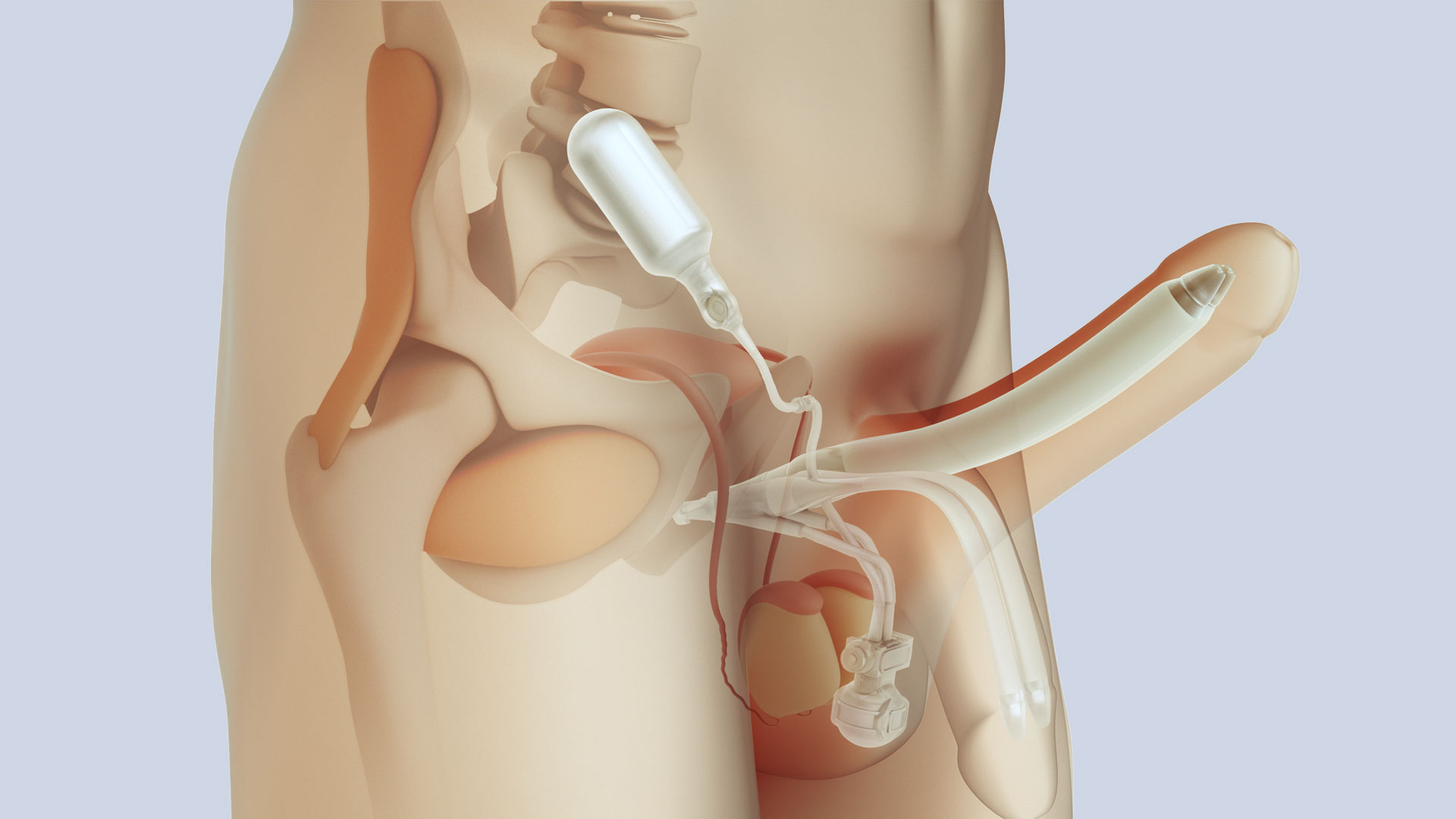
Inflatable Penile Prosthesis
Features of the inflatable penile prosthesis:
- Entirely concealed within the body.
- No adverse pharmacologic or hormonal effects one might experience with oral medications for ED.
- Provides a natural-like erection.
- The device is inflated to provide rigidity and deflated for concealment.
b) Malleable penile prosthesis:
Malleable prosthesis is the most effortless type of penile prosthesis. The prosthesis consists of a pair of malleable rods that are surgically inserted into the penis. The prosthesis is manually positioned up for sexual intercourse or down for concealment during daily activities.
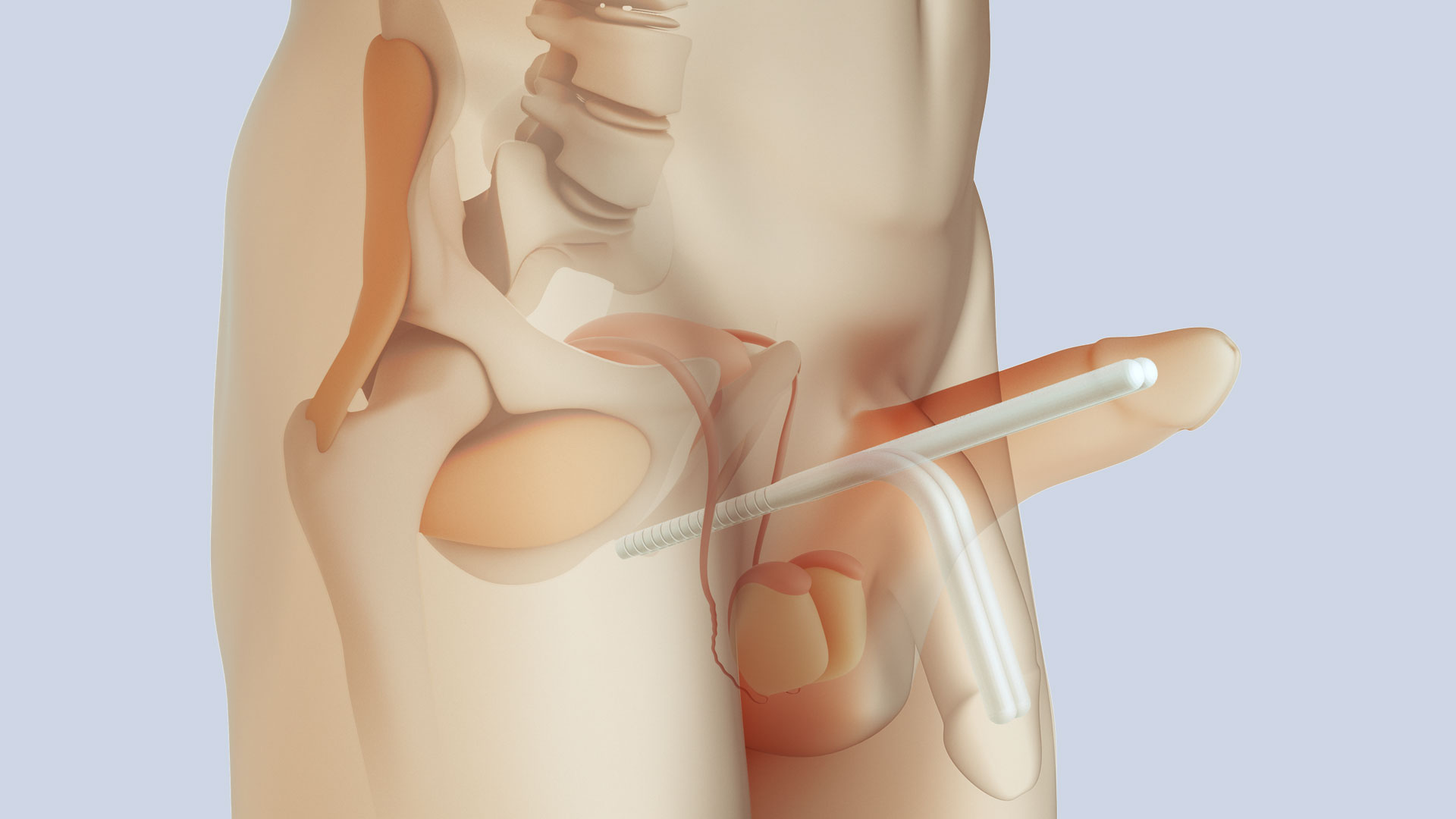
Malleable Penile Prosthesis
Features of the malleable penile prosthesis:
- Easier to use.
- Requires less manual dexterity.
- The simpler surgical implantation procedure.
- Lower risk of mechanical failure.
- Entirely concealed within the body.
- No adverse pharmacologic or hormonal effects one might experience with oral medications for ED treatment (when compared to the inflatable penile prosthesis).


Initial
Call
You will be called by experts to understand the severity of the condition


Verify Your Eligibility
You will be asked to visit our clinic in order to be checked for your eligibility of the penile prosthesis surgery


Decide On Date
Date of your surgery will be decided upon your arrival


Surgery
Time
Prof. Koenraad van Renterghem will take good care of you


Post
Surgical Care
Your condition after the surgery will be evaluated by Prof. Koenraad van Renterghem
Prof. Koenraad van Renterghem
- Member of the Executive Committee of the European Society of Sexual Medicine (ESSM)
- Member of the European Society of Genito-Urinary Reconstructive Surgery (ESGURS)
- Professor at Hasselt University, Faculty of Medicine, and consultant urologist at the University Hospitals in Leuven
- Member of the Belgian Association of Urology (BVU)
- Member of the European Association of Urology (EAU)
- Fellow of the European Board of Urology (FEBU)
- Full member of the EORTC and of the Recognition Committee for Urology


Jessa Hospital
Phone: +32 11 337670
Private Practice
Residentie Laegveld
Phone: +32 11 420401
Jessa Hospital
Private Practice Residentie Laegveld
Phone: +32 11 420401